Hi Sebcesoir, Exellent tests, although if you will allow me I would like to suggest an alternate workflow which I developed after I engaged in similar experiments, some years ago.
At the time I had just purchased an Alfa Romeo GTV6 24V (1998), what I consider to be one of the best designed cars in the world, and in combination with my attempts to learn how to model vehicles using nurbs, three important conclusions arose -
1 - That in essence we are dealing with organic - smooth, flowing, gradually changing forms, when we consider modern car designs: enter Zbrush.
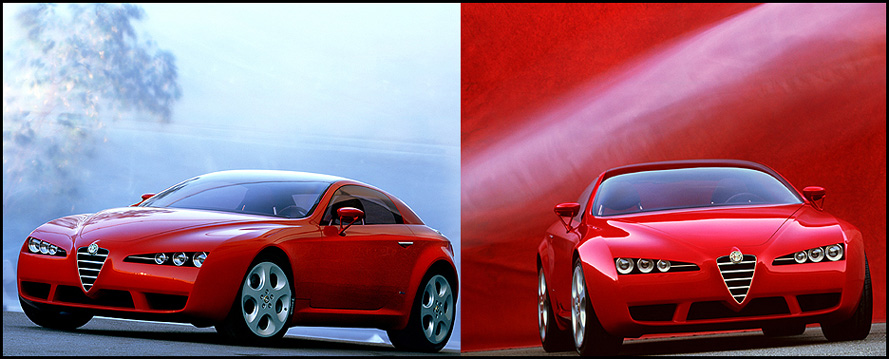
2 - The most difficult element of modelling with nurbs is not the construction of the ‘Surfaces’, but rather the creation and maintainance of intended volumes(here I use volumes and forms interchangably) and planes. This is because you are working curve by curve, patch by patch to contruct the final surface of the car/object.
3 - What I found after numerous experiments modelling helicopters, cars and ‘spaceships’, is that realistically, Zbrush can not be deployed for all elements of the non-organic modelling process. I’m implying the fine details - hard straight edges/creases, the metal panels that compose the surface of the car and so forth.
With enough time and an eye for perfection it may be possible, but it really is not a very efficiant undertaking in many respects.
The principles of creation of vehicles/object with nurbs, that I wrought from these realisations are as follows -
In effect we combine Zbrush modelling with nurbs modelling to solve the three problems simultaniously
1 - Amongst all the solutions for the formation of geomtry, in the creation of, not just details but also major forms, Zbrush is the most precise and flexible. The first principle involves the creation/imagination of the general volumes and planes of the vehicle inside Zbrush leaving all other details, aside from a few hard edges, to your nurbs modeller, at which they are profficient.
(I should[from reading the previews] say that with the next release of Zbrush this first step will become even easier and faster.)
2 - Once this form is created we may use the volume to help us in the creation of the nurbs curves. The important point to make here is that, now, maintaining the intended volume and planes becomes a trivial task. The volume can always be used as a solid reference point and contruction helper.
3 - Create nurbs patches and all details.(Again with the working out of your programs modelling functions and our polymesh volume as visual and contruction reference this is a far more simpler and enjoyable(:rolleyes:) task. ( Having a Shrink-Wrap type tool in your nurbs modelling program is of great help throughout this step.)
Note A - A method to traslate modifications of car size and changes in major form to the finished Nurbs model
By means of ‘Deformers’ I bind the nurbs model to my polymesh model so that the models maintained both positional and deformational continuety. As goes the worflow for facial expressions, I imported instances of the vehicle from zbrush, variations of the original design, and created a ‘morphing’ relationship between the orginal and variation model. I could then, with variable degree, modify the polymesh volume and thus that of the nurbs model, mixing and matching variations. Lengths and sizes can be modified any time with the greatest of ease.
Note B - When to use this method
This process is not suited to all non-organic modelling tasks and really would be a pointless exercise for modelling a keyboard or printer,say.
Note C - Why Nurbs
Why nurbs? Employing this method they are fast and very accurate. However with the next release of zbrush it is most likely they will become the second choice.
The key here for you, is not to bother modelling the fine details, once you have the form you can add them as textures, if you need reference to those features. Or now that I think about it, add them in the presentation of the design as ‘paint-overs’. I hope you can see, the reason as to how I say this, and that I’m aiming here for high quality high efficiancy modelling.
I apologies for the length of this post, more then anything I’ve written it for my self since when I was working on the project I did’nt really pay much attention to conceptualizing the principles - now that you’ve aroused my interest at another attempt 
Kircho
Edit - Spelling/Grammer - Changed first point of realisation because it was too equivocal.

 small_orange_diamond