
Attachments
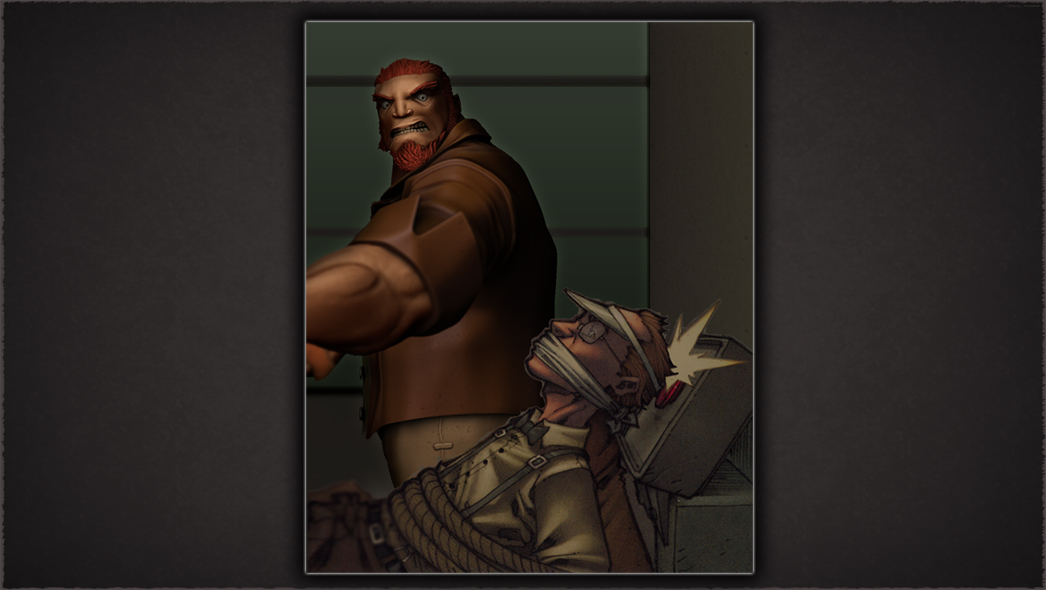
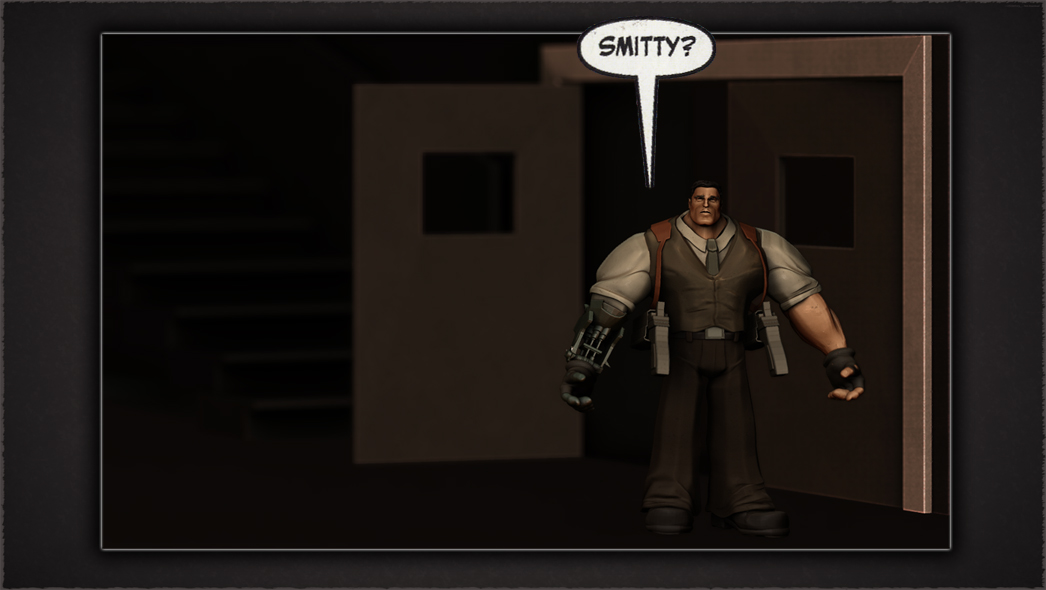
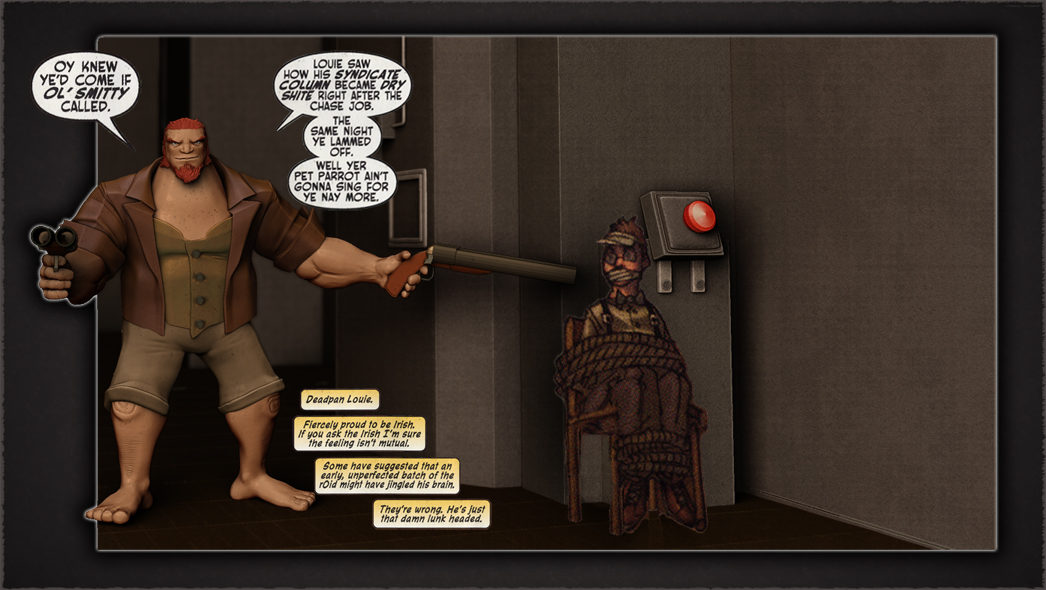
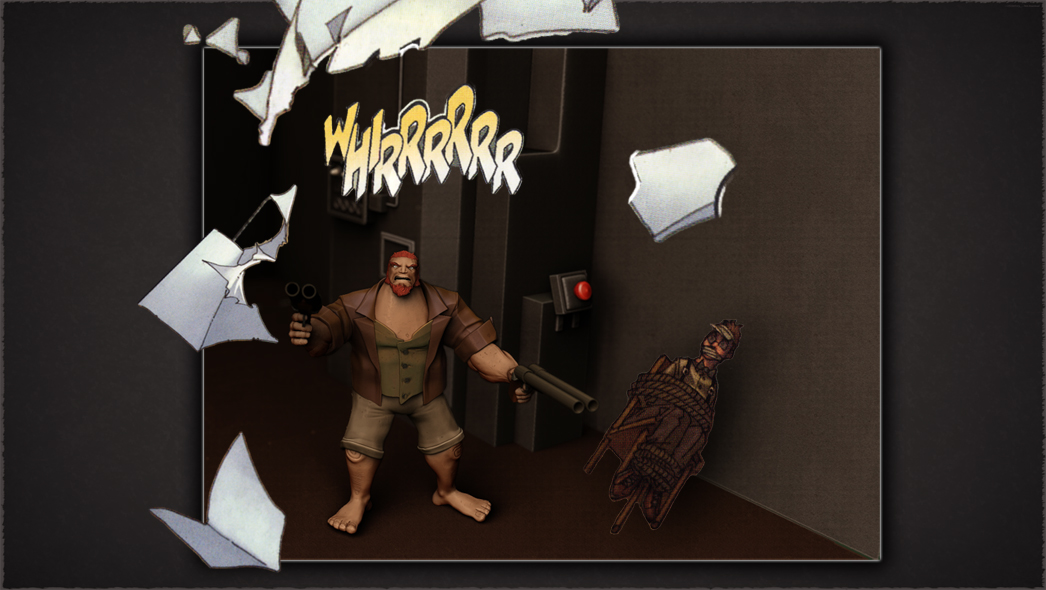
hi, cool characters you have there. i think you should exagerate the perspectives (fisheye, close ups…) to get a more dramatic look. also the poses of the characters seem a little stiff to me (line of action bla bla ). I hope i could help a little.
Some Books i really like on this theme:
Scott McCloud: Understanding Comics
Scott McCloud: Reinventing Comics
Scott McCloud: Making Comics
All the stuff by Preston Blair
Will Eisner : Sequential Art
…
Mint,
I really like the characters and like the rendering style
but I don’t get any feeling from the poses. You have alot of twinning going on(duplicate posing of arms and legs across the body). The characters also seem to be looking at the viewer in most of the shots, feels awkward.
I think you have some great stuff here!
Just work on your posing.
I agree that 3D comics could be very cool, and thought of trying one myself someday.
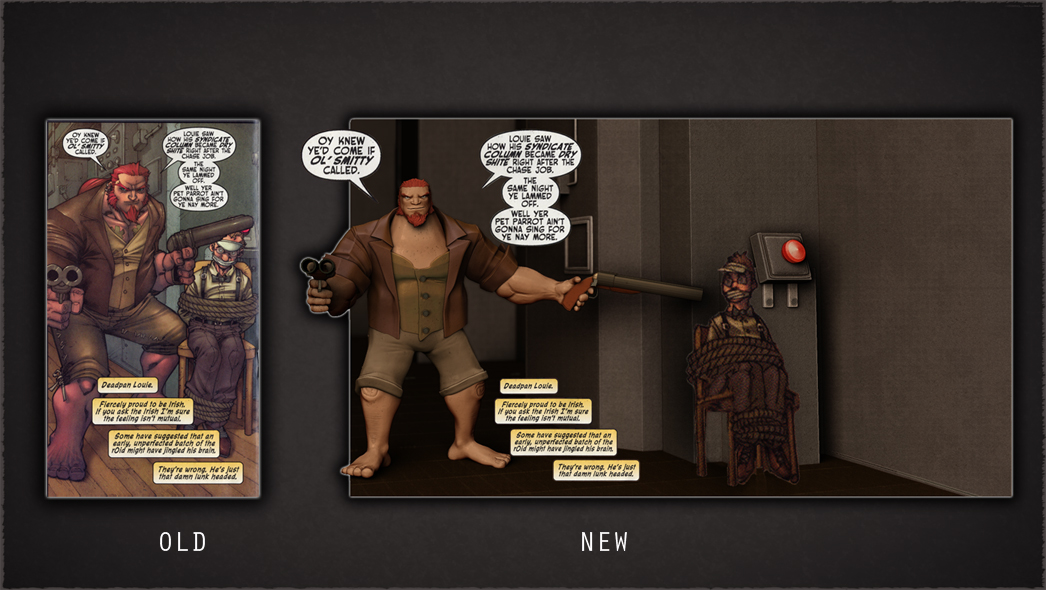
I notice two characters are 3d models, and one appears to be a cutout. Was that to save some time?
Also, it isn’t as clear as it should be that the character in the first panel is talking to the character with the guns in the second panel, because we never see a shot with both of them together showing their relative positions to each other. An “over the shoulder” shot would not only solve this, but it would also add some more drama.
I have to agree with benkenobi: You need to make more dramatic compositions in your panels. The characters look too static right now, and the “camera” is too far away, detaching the reader from the action. You want to put the reader right in the middle of the action. Use more powerful action poses. There is way too much “dead” space, or large areas where nothing important is happening: For instance, in panel two, half of the composition is just a blank wall, while panel one is mostly just an empty hallway. The panels should focus more on the action. In fact, since it is a 3D comic; why not take full advantage of that and have the characters bursting out of the panels like the 2D sample below?

Another good classic book to read on comics is, HOW TO DRAW COMICS THE MARVEL WAY.
I wish you success with your presentation.
Benkenobi and Turchik - Thanks to the link about the books if you like them then you may like what I have to say about comics, My research project took forward the idea of the Infinte Canvas by Scott Mcloud and I made something called the 3D Canvas - Example here
I agree alot that these poses look flat they are not my best examlple of prespective. I do have more some are better than others but they have not been render out yet this one used a small focal length to add drama .

Webhead - Yes one of them is cut out 2D to save time, he was only in the comic for 2 panels so wasn’t worth while making him for the time he would have been seen. I am glad you mentiond how it hard ot tell the relative position to each other… that was talked about in my research and my soultion to this is the “3D CANVAS” shown here. Hope this explains the panles better as they are not realy meant to be a stand alone item but to be view within in the 3d canvas.
Having checked out the 3D Canvas sample, the thing that stuck me is how much like “motion” comics the end result is. DC/Warner’s Watchmen motion comic came to mind as does the Marvel and Image web-only comics.
Like prose work, comics are “timeless” in the respect that the reader controls how quickly (or not) the work is being read. The sample (and the motion comics) don’t have this. And I think it’s the alteration of the gutter’s purpose from a “dividing timer” to a story-element container. What happens is that the resulting narrative becomes neither “comics” or “animation” but some hybrid that is deficient when compared to either “parent.”
Case in point, it seems that with the 3D canvas, the reader becomes a passive viewer because the scene changes are automatically done. There is no involvement needed by the viewer to get to the next part. In a paper-based comic I can linger over panels and get into the artistry involved. Thinking about the Perez art in “Legion of 3 worlds” mini or the Jones art from the first few issues of Final Crisis. Having read the first mini of “Iron and the Maiden” and experienced your adaptation – there’s nothing of the original, save for character design, remaining.
If the models would be rigged and enough morph targets made, then the figures could be more dynamic and the original panel compositions/camera angles could be transfered. Then, that leads us to how does one deal with the varying Level of Detail in comics. In hand-drawn comics, the artist may have a very detailed Establishing shot and then in some scenes may have a simplified figure that the reader recognizes as the figure from the previous panel. So when doing comics on a 3D canvas, ZBrush’s ability to keep previous subdivisions could come in handy.
One troubling thing is your statement that since a figure only appears in a panel or two, then a 2d cutout is efficient to use. However, this can throw the reader out of the suspension of disbelief that all storyteller try to maintain. During the production of the Incredibles, Pixar had to create many different characters and couldn’t spare the time to model each and every one separately. What they did was to create a “average” character and by using morph targets make that average character different enough that a plausable crowd scene could be created. The Principal and the Teacher from the first part of the film were both made with the “average” character, iirc.
But the biggest impediment I can see with 3D comics/canvas, is the sheer amount of time it would take to create. I can sketch. refine and render by hand (using Manga Studio) a character sheet in a fraction of the time it would take me to model, sculpt and texture (either by vertex painting or using UV maps) the same character. Now, once it’s finished, the 3D character model can be reused, but for expression and poses – morph targets and rigging would have to be created. This would be best for a factory-assembly line type of comic creation. But for a single cartoonist, this would be hard to do, but not impossible. The guy who does Dreamland Chronicles does his comic using a 3D program (I think 3D max). But most of the time, imho, the panels look more like stills from a animated feature, than actual panels in a story.
With all that being said, you’re onto something, Mint, and thanks for sharing it with the community at such a early stage. Part of me thinks that your purposes would be better served if you used a short story as the basis of your example. The current issue of House of Mystery (a Vertigo comic) has a few interesting short stories in it. Or some silver age 5-7 pagers done by Kirby, Dikto or Heck.
Y’know, Pixar started out doing shorts featuring a hopping lamp 
Mike Rhodes - Thank you so much for taking the time for youre detailed and useful feedback. I find what you have said very valuable It has been of great help to me.
I am glad you notived my alteration of the gutter’s purpose. This is one main component of the 3D canvas ( The Visavble Gutter ) the idea being that the gutter contains information. My intention is that the visalbe gutter/ 3d Canvas could be used as a sublte addttion to the readers closerbetween panles which would hopefully inhance nartative comprehension.
My research showed many people did not like Motion Comics , as you said comics are “timeless”. The way I intended for 3D canvas to be viewed was at first like a motion comic playing at real time. If this is not to the liking to the viewer they can use the Navigation arrows to view each Panel as a standalone image taking as long as they want to view the art work. This is possible with my current sample but hopefully when the site get updated next Friday it will be more obvious.
This will reduce the effect of the " Visible Gutter" to a minimum.Finally I would have like to be able to give the viewer the option to print the 3d canvas into a traditional format as I feel print is and always will be the most rewarding meduim for comics, something about hold the page can never be replaced by a computer screen.
There is still allot I would like to do with the " 3D Canvas" as I feel there is some potential here and I look forward to finding out where it will end up.
Once again thank you so much for your time your feedback will be very useful at my presentation and future development of the 3D Canvas.
Hey Mike - great feedback. I think a 3D comic would require a huge up front investment of time, but once you had rigged characters and set assets, some aspects may be quicker than 2D rendering (ie. being able to use a camera and easily re-posing).
For facial expressions you could morph the major expressions and than paint over them in Photoshop to make each one unique.
What would be difficult is large crowd scenes, dramatic drapery, changing clothing on your characters, etc. But as technology advances this may be less of an effort in the future. But for now, I agree, very difficult for a single artist.
What would be cool to see is someone combine 2D and 3D and come up with a really unique look.
Cheers,
Matt