ZBrushCentral

How are high poly dynamesh sculpts being used?

Question for discussion. What is the final use of most high-detail ZBrush sculpts? I see a lot of amazing work with hundreds of tiny parts and details. The thought of retop-ing all of it for some sort of game or even animation use seems mindblowing for some of them.

So it seems that in the end most would be useful only in creating still images or 3D printing. Which is not at all bad. I guess part of where I’m coming from is that I created a character that was originally meant to be a low-poly game character. I then discovered many of the options like insert mesh and Curve Tubes that allow me to quickly create some detailed geometry. But now I have ended up with a model that has some details (like shoelaces with gromets) that I can’t bear to part with but have horrible geometry for a game engine and would be very nasty to retop. Comments?
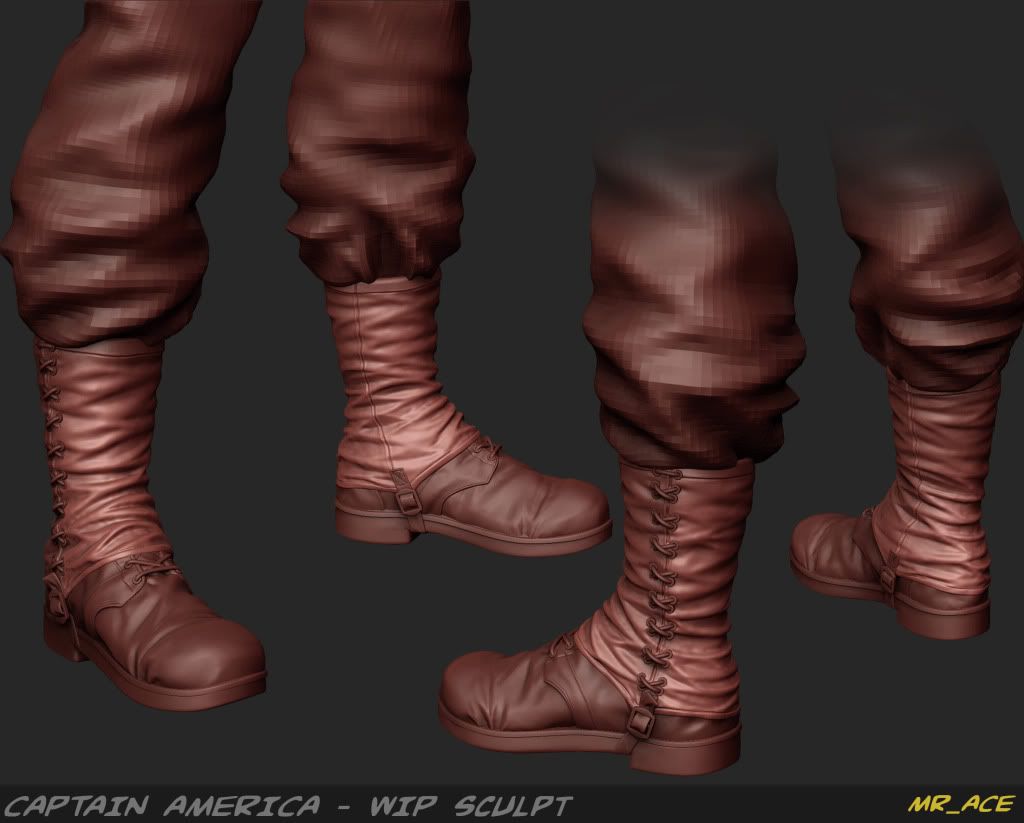
The high res sculpts can be baked down into displacement and normal maps for film and games.

When it comes to the final retopology, you don’t have to retopologize every component from the sculpt. Games for example put the focus on maintaining the silhouette in the final model, as the other details would be recreated through the various texture maps. So something like a shoelace wouldn’t have to be included in the final low poly model.

As a visual example, with a boot sculpt like this I can easily see around 63 separate components per boot (it doesn’t matter if they are 63 different subtools, or just several meshes merged into a single subtool to keep the clutter down). There are all sorts of islands for the various laces, their gromets, the cloth, each piece of leather that create the boot can very well be separated, the rubber, the strap, the straps’ buckle, etc. But in the final retopologized low-poly mesh, all that’s required is enough geometry to support the silhouette and any deformation required of it. In this case one simple mesh covers the bulk of the foot while the strap appears to be a separate island.

Thanks, I appreciate the response and the examples.

I guess part of it too is that I’d love to be able to just sculpt in Dynamesh and other tools with little worry about geometry and then feel that I’m done when the sculpt looks good. But I guess the purpose of using Dynamesh when you’ll have to retop anyway is that you don’t waste time building solid geometry for a design that may change. With Dynamesh you can quickly sculpt and change the design and then once the design is final you can spend a few hours in retop to get something useable.

I’d be curious if there are any professional uses of ZBrush that don’t require a retop at the end of everything? Solid model making (using Decimation Master) and still image creation seem to be the only two that I can think of.

It’s a modeling program, so like most modeling programs the end result (with or without retopology) is either a 3d model, or an image of one (to be used either as an image, as part of an image, or as part of a series of images that create a movie).

I wouldn’t advise someone to avoid getting familiar with retopology, as it’s a common task even in traditional modeling programs. The reason you see it more when it comes to sculpting applications is that standard 3d programs usually aren’t designed to handle tens of millions of vertices in viewport, especially when you need to start adding several deformers, UVs, etc to every single vertex. Otherwise there’s no difference; edges are still edges, vertices are still vertices, pixels are still pixels.